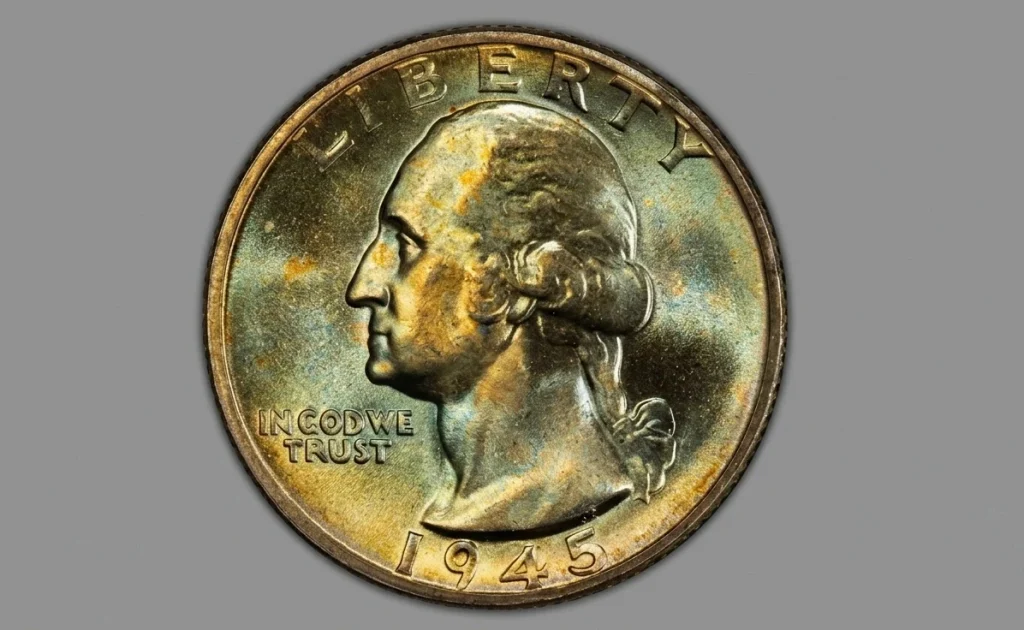
Subtle wear defines its category.
Market performance for the 1945 Washington series remains strictly dependent on verified surface preservation data.
A 1945 quarter value formation relies on public trade data recorded over the previous twelve months.
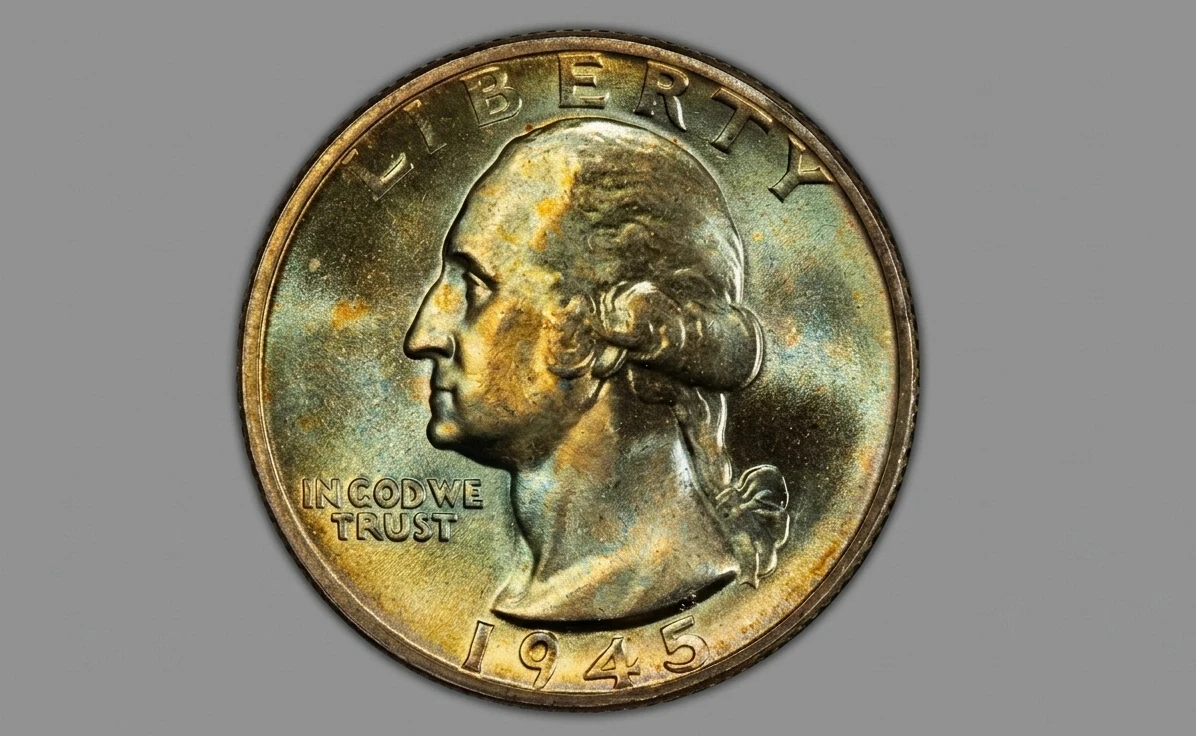
| Parameter | Value |
| Mass | 6.25 grams |
| Composition | 90% Silver, 10% Copper |
| Diameter | 24.30 mm |
| Thickness | 1.75 mm |
| Edge Type | Reeded |
Weight deviations exceeding 0.20 grams from the 6.25 grams standard indicate potential counterfeiting or extreme circulation loss.
High silver content provides a distinct white luster when lacking oxidation.
Minting Statistics by Production Facility
Total 1945 production volume was distributed across three primary locations.
Manufacturing origin is identified by the mint mark located on the reverse side.
- Philadelphia no mint mark → 74,372,000 units
- Denver D mark → 12,341,600 units
- San Francisco S mark → 15,232,000 units
Philadelphia production exceeds the combined output of other facilities by a factor of 2.6.
Denver specimens represent the highest scarcity due to the lowest production volume for this specific year.
Grading Classification via Sheldon Scale
Third party certification from PCGS or NGC serves as a mandatory requirement for high value transactions.
Surface condition is categorized by a numerical index ranging from 1 to 70.
- MS67. Perfect mint luster showing no visible contact marks.
- MS65. High quality strike allowing for minor microscopic abrasions.
- AU58. Light friction appearing on the highest points of Washington’s hair.
- XF40. Feather detail on the eagle remaining visible across 80% of the area.
- VF20. Major design elements staying sharp despite general relief flattening.
Achieving an MS68 grade renders a coin unique as registry counts remain limited to single digits.
Auction Price Dynamics in 2026
Inflationary pressure and supply shortages affecting high grade material drive final hammer prices.
| Condition | Philadelphia Value | Denver Value | San Francisco Value |
| MS64 | $35 | $45 | $40 |
| MS65 | $55 | $75 | $65 |
| MS66 | $110 | $160 | $145 |
| MS67 | $650 | $1,200 | $850 |
| MS68 | $14,000 | $22,000 | $18,500 |
Record pricing for a 1945-D specimen in MS68 reached $23,450 at Heritage Auctions.
Annual appreciation for coins graded above MS66 maintains a steady 8.5% rate.
Causal Factors in Price Determination
Environmental variables and market conditions dictate asset liquidity.
Shift in demand vectors → Price list adjustments.
- Rising silver spot price → Increasing baseline value for low grade circulated coins.
- Discovery of new bank hoards → Temporary price dips resulting from supply surplus.
- Entry of new institutional investors → Heightened competition during major auctions.
- Stricter grading standards → Price premiums for older certified holders.
Lower silver content in modern circulation increases the intrinsic value of 1945 silver issues.
Analysis of Damage and Circulation Marks
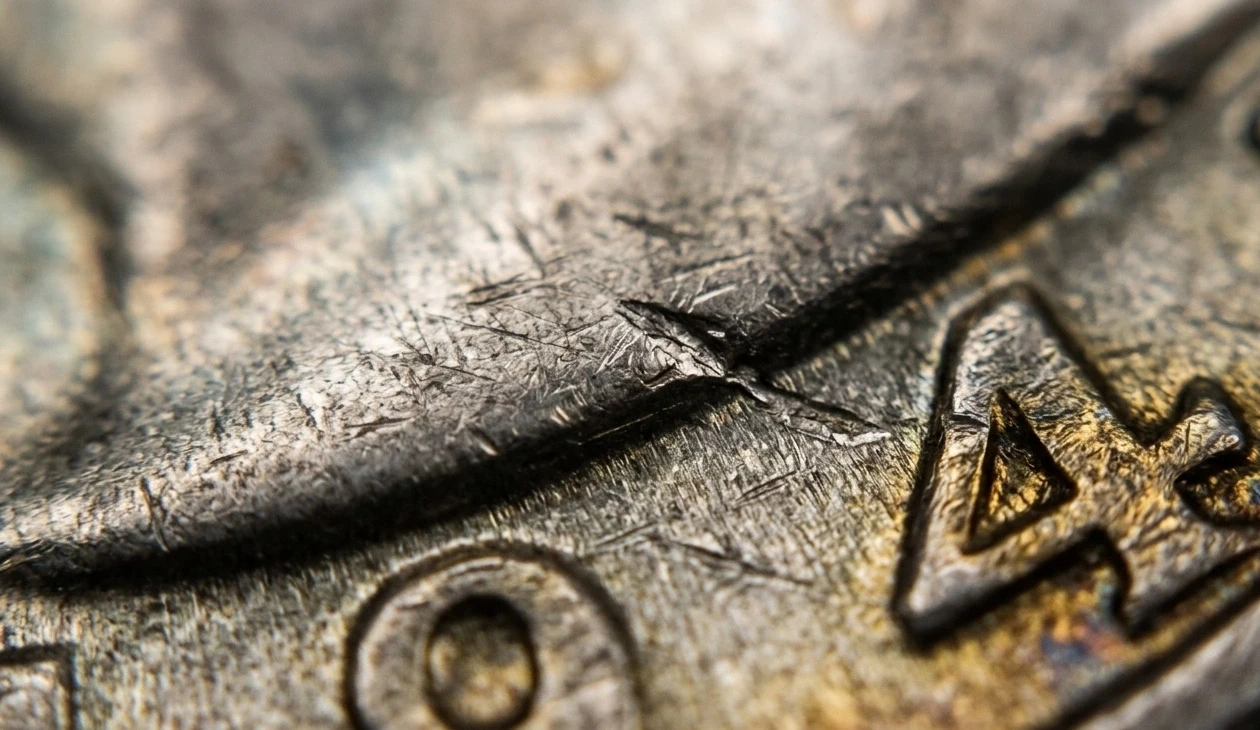
Mechanical flaws reduce estimated value by a specific percentage.
Physical impacts irreversibly distort the original engraved relief.
- Scratches on the field. Value reduction of 45%.
- Rim nicks or dings. Value reduction of 20%.
- Evidence of chemical cleaning. Value reduction of 70%.
- Deep black oxidation. Value reduction of 15%.
Natural rainbow toning can contribute up to a 25% price premium.
Loss of original mint bloom moves the coin into the bullion scrap category.
Variety Specifics and Minting Errors
Technological failures during production create rare die variants.
Identifying micro-details requires the use of the free coin value checker.
- Doubled Die Obverse DDO. Evident on the lettering of the word LIBERTY.
- Repunched Mint Mark RPM. Frequently observed on Denver and San Francisco strikes.
- Die cracks. Appearing as raised lines across the coin surface.
Specimens possessing verified significant doubling trade at 5 times the standard market rate.
Production errors on 1945 quarters occur less frequently than on those from the early 1940s.
Correlation Between Mass and Wear
Weight loss serves as a primary indicator of prolonged circulation time.
Relation between gram weight and market category:
Weight 6.25g — 6.20g → UNC or AU condition.
Weight 6.20g — 6.10g → XF or VF condition.
Weight 6.10g — 5.90g → Fine condition or lower.
Weight below 5.85g → Coin unsuitable for numismatic collection.
Mass reduction of 5% signifies total loss of collectible premium.
Storage Methodology for Value Preservation
Improper housing leads to irreversible metal surface degradation.
Chemical oxidation processes occur when exposed to moisture and sulfur.
- Using PVC albums → Appearance of sticky green residue.
- Storing in paper envelopes → Accelerated darkening of coin edges.
- Touching fields with fingers → Creation of permanent skin oil marks.
- Airtight inert plastic capsules → Optimal protection method.
Certified slabs protect the metal from mechanical impact and atmospheric pollutants.
Comparative Analysis With Adjacent Years
Contextual understanding requires comparing 1945 with 1944 and 1946.
Production totals varied significantly based on economic requirements.
1944 Year → 104 million units. Lower price due to mass availability.
1945 Year → 74 million units. Mid-range pricing tier.
1946 Year → 53 million units. Potentially higher future scarcity.
Total 1945 volume remains balanced for building a diversified investment portfolio.
Instructions for Manual Verification
Preliminary inspection allows for filtering out low quality specimens.
Steps for evaluation in a home environment:
- Weighing on electronic scales providing 0.01g precision.
- Testing magnetic properties to exclude steel counterfeits.
- Checking the coin via the coin identification app.
- Examining central relief details including hair lines above the ear and eagle claws.
- Comparing luster against a verified silver 900 sample.
- Presence of sharp vertical lines on the eagle feathers confirms preservation at the EF level.